
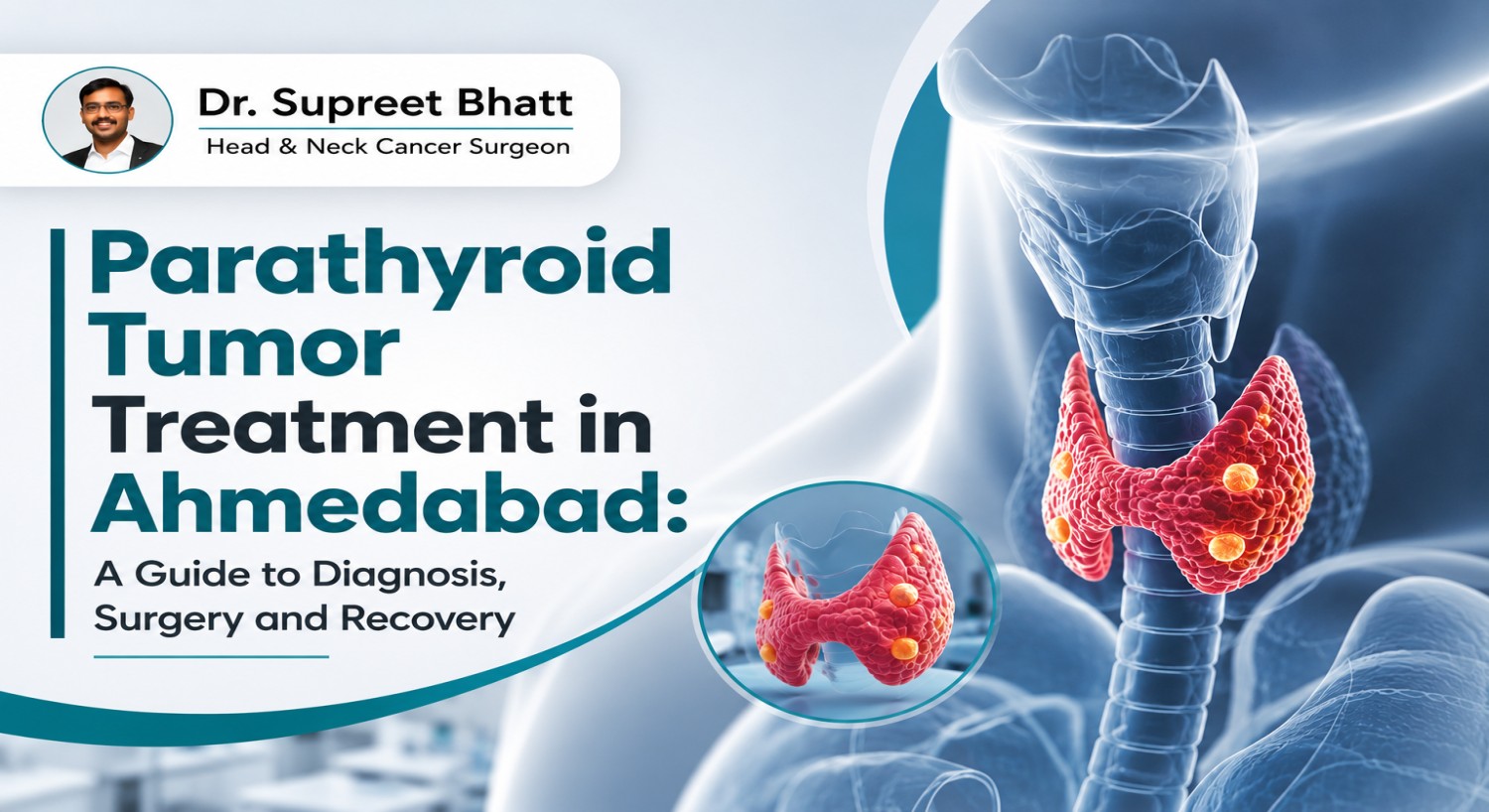
It usually starts with a routine blood test. A calcium reading comes back a little too high, and suddenly a patient is being asked questions about fatigue, bone aches, or kidney stones they had almost stopped noticing. As Dr. Supreet Bhatt explains, the culprit is often one of the four parathyroid glands, tiny, rice-grain-sized structures located behind the thyroid that quietly regulate calcium levels in the blood. When one of these glands becomes overactive, the effects can appear in places patients may not immediately connect to the condition, including brittle bones, persistent fatigue, and kidney problems.
If you're trying to understand your options for parathyroid tumor treatment in Ahmedabad, this guide covers what these tumors are, how doctors diagnose them, and what surgery and recovery actually look like.
Understanding Parathyroid Tumors
The parathyroid glands work like a thermostat for calcium. When blood calcium dips, they release parathyroid hormone (PTH), which pulls calcium from the bones and holds onto more of it in the kidneys. It's a tightly regulated system until a tumor develops in one of the glands and throws the whole feedback loop off balance. The gland simply stops listening to the body's calcium levels and keeps churning out PTH regardless.
The Different Types
Not every parathyroid growth behaves the same way, and the distinction matters for treatment planning.
- Parathyroid adenoma is by far the most common finding. It's a benign tumor in a single gland, and it doesn't spread beyond the parathyroid itself.
- Parathyroid hyperplasia is a different pattern altogether, instead of one gland misbehaving, all four enlarge and overproduce hormones together. It's still non-cancerous, but because multiple glands are involved, the surgical approach has to be adjusted accordingly.
- Parathyroid cancer, thankfully, is rare, it accounts for roughly 1% of primary hyperparathyroidism cases. When it's suspected, the surgeon typically removes the affected gland along with nearby thyroid tissue and lymph nodes to ensure nothing is left behind.
Who Is at Risk?
There's no single cause behind most parathyroid tumors, but a few factors do raise the odds:
- Previous radiation exposure to the head or neck
- A family history of parathyroid or other endocrine tumors
- Being a woman over the age of 50
- Rare inherited conditions such as Multiple Endocrine Neoplasia type 1
That said, plenty of patients have none of these risk factors and still develop a tumor, which is exactly why calcium screening during routine check-ups is worth taking seriously, particularly if endocrine conditions run in the family.
Recognizing the Symptoms
Because calcium touches so many systems in the body, parathyroid disease tends to masquerade as something else entirely, general tiredness, aging joints, or just "having an off year." Symptoms worth paying attention to include:
- Bone pain or fractures that seem to happen too easily
- Kidney stones or a nagging ache in the lower back
- Unusual thirst paired with frequent urination
- Persistent fatigue, weak muscles, or a low mood that won't lift
- Nausea, constipation, or a shrinking appetite
- Foggy thinking or memory lapses
- A lump in the neck, though this is far less common
When a cluster of these symptoms shows up together, a simple blood test checking calcium and PTH levels is usually the logical next step.
Does a Parathyroid Tumor Mean Cancer?
Not usually. The overwhelming majority of cases turn out to be benign adenomas or hyperplasia. Parathyroid cancer exists, but it's uncommon, and even then, timely surgical removal tends to produce good outcomes.
How Doctors Diagnose It
Diagnosis starts with blood work calcium and PTH are checked together, since both need to be elevated for a diagnosis of primary hyperparathyroidism to hold up. Once that's confirmed, imaging comes next, and its job is to pinpoint exactly which gland (or glands) is causing the trouble.
Ultrasound offers a fast, radiation-free look at enlarged glands and is often the first imaging test ordered.
Sestamibi scans use nuclear imaging to highlight overactive parathyroid tissue that might not show up clearly otherwise.
CT scans provide more detailed anatomical mapping, useful in complex or unclear cases.
Venous sampling is reserved for the trickier situations, when a tumor is proving hard to locate, or when a patient has already had one parathyroid surgery and scar tissue complicates the picture.
Getting this localization right before surgery matters. It's what allows the surgeon to go in with a precise, minimally invasive plan instead of exploring the entire neck.
Treatment Options
Active Surveillance
For patients whose hyperparathyroidism is mild and not causing symptoms, doctors sometimes recommend active surveillance, regular checks on calcium levels, bone density, and kidney function rather than jumping straight to surgery. It's a reasonable path when the disease is stable and not progressing.
Parathyroid Surgery
For most patients, surgery is still the most reliable way to resolve the problem, whether the tumor is benign or cancerous. The surgeon removes the abnormal gland (or glands) through a small incision, usually placed along a natural crease in the neck so the resulting scar fades and becomes hard to notice.
One detail that sets modern parathyroid surgery apart is intraoperative PTH monitoring, checking hormone levels in real time while the patient is still on the table. Once the problem tissue is out, PTH should drop sharply within minutes, giving the surgical team immediate confirmation that the operation has worked.
Minimally Invasive Techniques
Better imaging and refined surgical technique now make it possible to remove parathyroid tumors through very small incisions in many cases. Patients generally experience less discomfort afterward and get back to their routines faster than with more extensive neck surgery.
Recovering After Surgery
Recovery tends to be smoother than patients expect. Most people go home the same day or the next, and light activity resumes within roughly a week. Aftercare typically includes:
- Close tracking of calcium and PTH levels in the days right after surgery
- Short-term calcium or vitamin D supplements if levels dip post-op
- Continued management of any existing complications, like osteoporosis or kidney stones
- Follow-up blood work over the following months to confirm everything has stabilized
Patients who pursue parathyroid tumor treatment in Ahmedabad before complications like fractures or kidney damage set in generally have an easier recovery and fewer follow-up visits down the line.
Finding the Right Surgeon
Because the parathyroid glands sit close to delicate structures like the recurrent laryngeal nerve, surgical precision isn't optional, it's the whole game. A surgeon who has handled both routine adenomas and the rarer cancerous cases brings a level of judgment that adapts to each patient's anatomy, rather than applying the same approach to everyone.
Dr. Supreet Bhatt, a Consultant Head & Neck Cancer Surgeon at Zydus Cancer Centre, Ahmedabad, has spent over 13 years treating head and neck conditions, including more than 20,000 patients across his practice, with hands-on experience in both benign and malignant parathyroid disease. His approach pairs minimally invasive surgical technique with close hormonal monitoring, aiming for both a clean removal and a comfortable recovery.
Frequently Asked Questions
What's usually the first sign of a parathyroid tumor?
Most of the time, there isn't an obvious early warning, it's an elevated calcium level picked up during a routine blood test. When symptoms do show up, fatigue, bone pain, and kidney stones are among the most common.
Is parathyroid surgery a major procedure?
Not typically. Most cases today are handled through minimally invasive surgery, a small neck incision, a relatively short operation, and a quicker recovery compared to more extensive neck procedures.
How long does it take to recover after parathyroid surgery?
Many patients head home the same day or the next, with light activity resuming within about a week. Calcium levels are usually confirmed stable over the following weeks. For more information about thyroid surgery and recovery, read our detailed blog.
Can a parathyroid tumor come back after it's removed?
Recurrence is uncommon once an adenoma has been successfully removed. Patients with hyperplasia or hereditary conditions like MEN1 do need ongoing monitoring, since more than one gland can be involved over time.
Are parathyroid tumors always cancerous?
No, the vast majority are benign, either adenomas or hyperplasia. Parathyroid cancer is rare, making up only about 1% of primary hyperparathyroidism cases.
Final Thoughts
Parathyroid tumors are often quiet troublemakers, benign in most cases, but capable of chipping away at bone strength, kidney function, and everyday energy if left unchecked. Catching the symptoms early, getting the right blood work and imaging done, and choosing a surgeon with real experience in this area go a long way toward a full recovery.
For anyone weighing their options for parathyroid tumor treatment in Ahmedabad, working with someone who understands both the hormonal and surgical sides of this condition makes the path forward much clearer.
Dr. Supreet Bhatt and his team at Zydus Cancer Centre continue to guide patients through that process, from the first diagnosis to long-term follow-up. schedule a consultation with Dr. Supreet Bhatt to discuss the right treatment options and take the next step toward better health.

About the Author
Dr. Supreet BhattHead and Neck Cancer Surgeon and Thyroid Surgeon, Senior Consulatent Zydus Cancer Center
View all articles →